
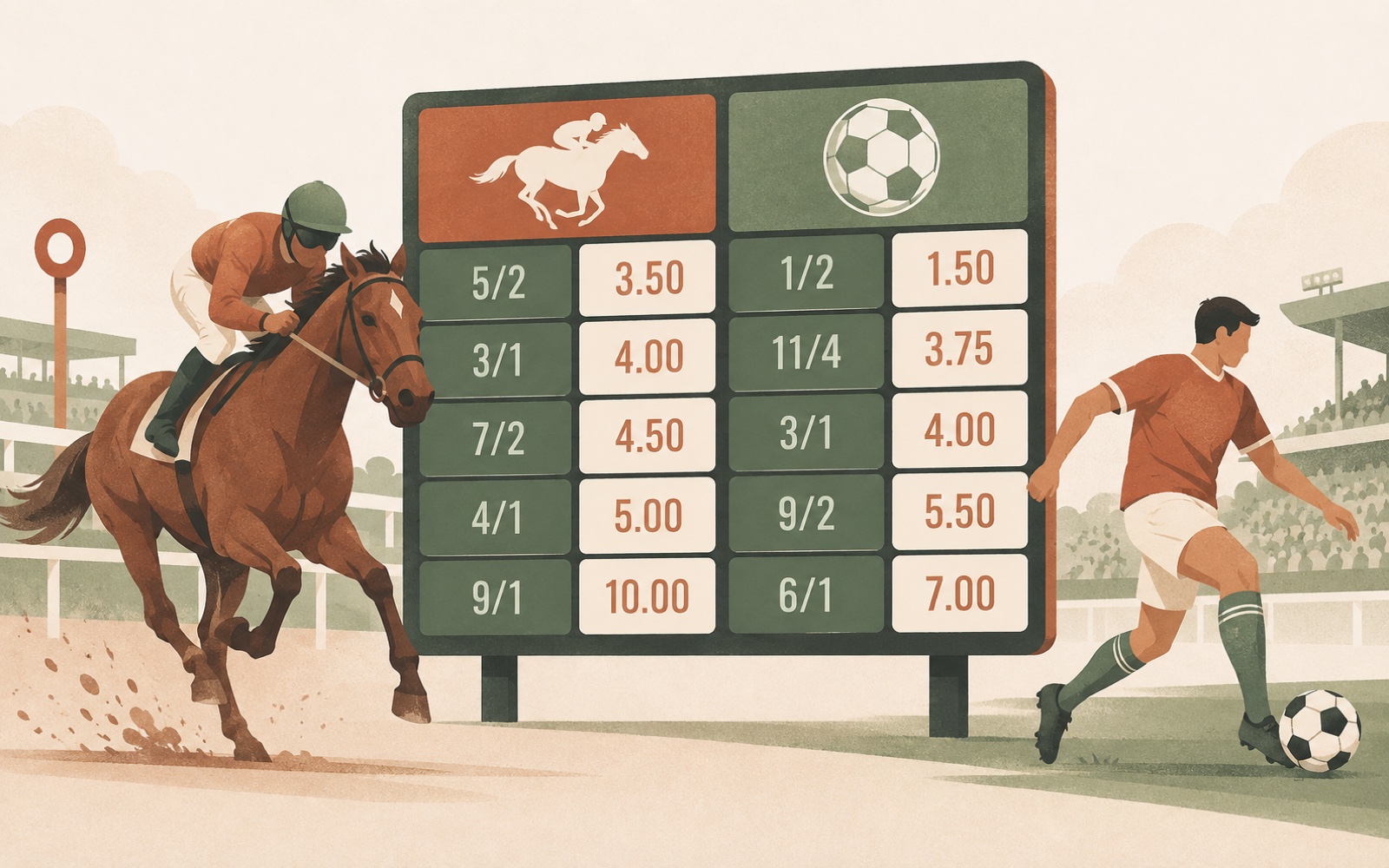
Strip away the graphics and a bookmaker is a shop that sells one thing: probability, marked up. The odds on a selection are that probability expressed as a price, and every price includes a margin that tilts the average result towards the house. None of that is a secret, and once you can read it the marketing loses most of its power over you.
This page is the numerate core of the site. It shows how to read a price, convert between the two notations, measure the margin, and use those skills to tell a keen book from a greedy one. The maths is simple arithmetic, and it repays the ten minutes it takes to learn.
01
How a betting price is written and read
A price answers one question: what will a winning £1 return? At evens you get your £1 back plus £1 profit. At 3/1 you get your £1 back plus £3. The price also carries the implied probability of the outcome, because a shorter price means the book thinks the event is more likely. Reading odds fluently means seeing both the payout and the probability at once.
The implied probability is 1 divided by the decimal price. A 2.00 shot implies 50 per cent, a 4.00 shot implies 25 per cent, a 1.50 shot implies about 67 per cent. Hold that conversion in your head and every price becomes a percentage you can sanity-check against your own view of the event.
02
Fractional and decimal, two ways to write one price
British sites show both notations, and they describe the same price. Fractional gives profit to stake, so 5/2 means £5 profit for every £2 staked. Decimal gives the total return per £1 including the stake, so the same price is 3.50. To convert, divide the fraction and add 1: 5/2 is 2.5, plus 1, equals 3.50. To go back, subtract 1 and express as a fraction.
Decimal is the more useful for a value punter because it totalises. You cannot easily add 4/6, 11/4 and 7/1 in your head, but you can add 1.667, 3.75 and 8.00, and dividing 1 by each lets you sum a whole market in seconds. That is the step that exposes the margin.
A worked example
A tennis match is priced 4/6 the favourite and 11/8 the underdog. In decimal that is 1.667 and 2.375. The implied probabilities are 1 divided by 1.667, which is 60 per cent, and 1 divided by 2.375, which is 42.1 per cent. They sum to 102.1 per cent, so the overround on this two-way market is about 2.1 per cent, a keen book.
03
The margin and how the book is balanced
A fair coin should be 2.00 each side, and those two prices sum to exactly 100 per cent. No bookmaker offers that, because there would be no profit in it. Instead the prices are shortened so the implied probabilities sum to more than 100, and that excess, the overround, is the margin. On a well-run football match result you might see around 5 per cent; on a 20-runner handicap the overround can exceed 25 per cent once every runner's slice is added.
The margin is why the average customer loses over time even with no bad luck. It also varies hugely between sites and between markets, which is precisely why comparison pays. A site that runs a 4 per cent book on your markets is handing back more of your money than one running 8 per cent, every single bet.
| What to check | Why it matters | Where |
|---|---|---|
| UKGC licence | Legal to serve UK, dispute route | Public register |
| Safer-gambling tools | Limits, time-outs, self-exclusion | Account settings |
| Payment terms | Debit only, clear withdrawal times | Banking page |
04
Why comparing prices pays every time
The difference between 2.00 and 2.10 sounds trivial until you count it. A winning £10 stake returns £20 at the first price and £21 at the second. That extra pound is 5 per cent, and taken across a hundred settled bets in a season it dwarfs almost any welcome offer. Taking the best available price is the one habit that reliably improves long-run returns.
Comparison need not be elaborate. Pick the selection you intend to back, read the decimal price on two or three licensed sites, and take the largest. Do that consistently and you are, in effect, lowering the margin you personally pay without changing anything else about how you bet.
Key points
- Implied probability is 1 divided by the decimal price; sum a market to find the overround.
- Under about 5 per cent is a keen book on a simple market; over 8 per cent is wide.
- Always take the best of two or three licensed sites; see how to compare sites first.
05
Markets, in-play and the bet builder trap
Not all markets are priced alike. Simple two-way and three-way books tend to be tightest, because competition forces them keen. Outrights, specials and bet builders carry fatter margins, and in-play prices move fast and often sit a little wider to cover the operator's risk. Knowing this lets you choose where to bet, not just what.
The bet builder is the clearest trap. Combining several legs from one match feels clever, but the margin on each leg multiplies. It is also where correlation is quietly priced against you, since the legs are rarely independent. The headline return dazzles; the compounded overround does the damage.
A worked example
Four legs, each with a 5 per cent margin, do not add to 20 per cent, they compound. Roughly 1.05 to the fourth power is about 1.216, an overround near 22 per cent before a ball is kicked. The same four selections backed as singles, each at the best compared price, would cost you a fraction of that edge.
06
Value, staking and the discipline that protects it
Value is a price longer than the true chance, and it is the only thing that turns a profit if it exists at all. You cannot measure true chance exactly, but you can refuse to bet into wide books and you can always take the best available price, both of which improve your expected return. That is the numerate case for discipline: it does not guarantee wins, it reduces the edge working against you.
Staking protects whatever value you find. Keep each stake to a flat, modest fraction of your bankroll, do not increase stakes to chase losses, and accept that variance means losing runs are normal even when every bet was sensibly priced. Set a deposit limit so the budget is fixed before emotion arrives.
07
Where promotions hide the real price
Promotions are priced too, and usually against you. A boosted price on one selection can sit alongside wider margins across the rest of the book, and a free bet must be turned over on terms before it becomes withdrawable. Since 19 January 2026 wagering requirements are capped at 10 times the bonus and mixed sportsbook-and-casino promotions are banned, which limits the worst of it, but the arithmetic still favours the house.
Read a promotion the way you read a price. What is the minimum odds requirement, the expiry, the maximum stake counting towards it? Weigh that against a genuinely keener everyday book, and the plain sharp price almost always wins. The offer is marketing; the margin is the product.
Related reading on this site
- Comparing betting sites step by step
- Confirming a site on the UKGC register
- How deposits and withdrawals work
- Deposit limits and staying in control
- When a price signals a site to avoid
How we check our facts
The odds conversions and overround method here are standard arithmetic; the rules on wagering requirements, the credit-card ban and stake limits are published by the UK Gambling Commission and GOV.UK, and support information is from GamCare and BeGambleAware. Last checked 25 September 2026.

Frequently asked questions
What does the overround mean and why should I care?
The overround is the bookmaker's built-in margin. Add up 1 divided by the decimal price of every outcome in a market: a fair book would total 1.00, or 100 per cent, but a real one totals more, and the excess is the operator's edge. A market summing to 1.05 carries a 5 per cent overround. The lower it is, the more of your money is returned over time, so it is the single most useful number to compare between sites.
How do I convert fractional odds to decimal?
Divide the first number by the second and add 1. So 5/2 is 2 divided into 5, which is 2.5, plus 1, giving 3.50. Evens, or 1/1, is 2.00. The decimal figure is your total return per £1 staked including the stake, which makes it far easier to compare prices and totalise a market than fractions are.
Is a bet builder or accumulator ever good value?
Occasionally, but the odds are stacked against it because the margin compounds across every leg. If each leg carries a 5 per cent edge, a four-fold multiplies that to roughly 22 per cent before the event starts. The long return is the lure; the widened book is the cost. A single at a carefully compared price usually offers better value than a multiple with the same headline payout.
What is a value bet and can I rely on finding them?
A value bet is one where the price is longer than the true probability of the outcome, so it would pay a profit if the same bet were repeated many times. You cannot see true probability directly, and no method guarantees you will find value, but a low margin leaves more room for it to exist. Betting is not income; comparing prices and staking sensibly only narrows the house edge, it does not erase it.