
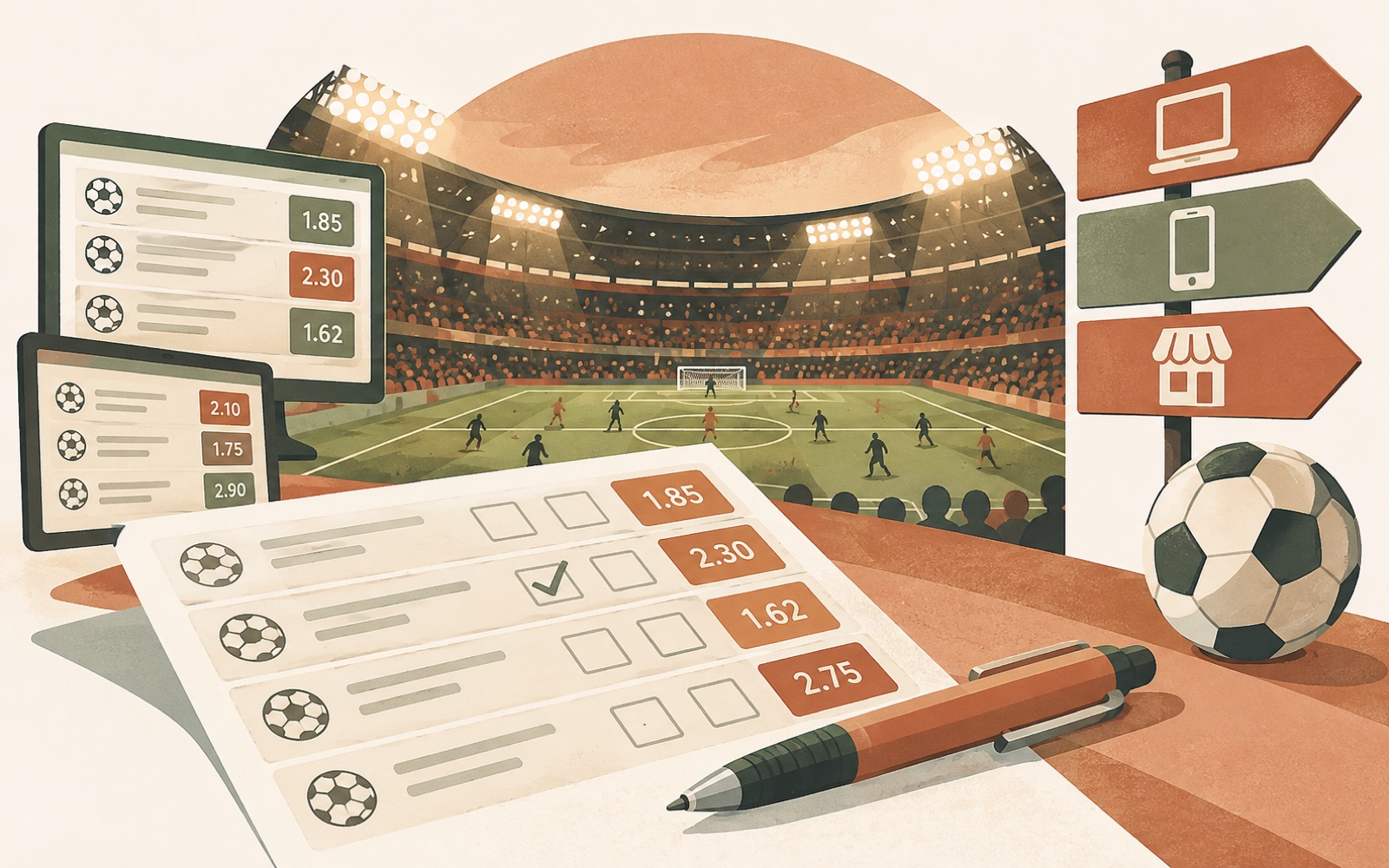
Ask ten punters for the best betting site and you will get ten answers, most of them shaped by an advert. This guide takes a colder look. The site worth your money is the one that returns the largest share of the true chance to you, pays out without fuss, and lets you keep control of your stake. Everything else, the free bets, the app graphics, the accumulator gimmicks, is noise laid over a single number: the price.
Because betting is a money matter, the checks start with the law rather than the odds. Only an operator licensed by the UK Gambling Commission may lawfully take bets from customers in Britain, and only a licensed operator gives you a dispute route if a payout is refused. Once that box is ticked, the rest of this page is about squeezing value out of the numbers and keeping your betting safe.
01
What the phrase best betting sites really means
To a marketer the phrase means the biggest welcome offer. To a numerate punter it means the smallest margin. Every price a bookmaker quotes contains a built-in edge, the overround, and that edge is the house's long-run profit. A market with a 3 per cent overround hands you back more of your money over time than one at 8 per cent, regardless of which logo sits above it. So the first job is to translate the marketing question into an arithmetic one.
Judge a site on four measurable things: the licence, the margin on the markets you actually bet, the speed and reliability of withdrawals, and the strength of the tools that let you set limits. A site can have a slick app and still take an extra few per cent on every price, which is money out of your pocket on every settled bet. Treat the odds as the product and the promotions as wrapping paper.
None of this asks you to become an expert trader. It asks you to reorder your priorities so that the price comes first and the marketing comes last, and to carry a handful of habits into every bet: check the licence once, compare the price every time, know your withdrawal route, and set your limits before you need them. A punter who does those four things has already put more distance between themselves and the average customer than any welcome offer ever could, and has done it without staking a single extra penny more than they had already planned to.
02
The factors that decide value, not the ones in the adverts
Rank the factors by how much they cost you across a year of betting. Price comes top, because a habit of taking 2.10 instead of 2.00 on the same selection adds 5 per cent to every winning return, and that dwarfs a one-off bonus. Withdrawal reliability comes next, because winnings you cannot easily draw are not really yours. Then come the safer-gambling controls, the clarity of terms, and only last the promotions.
Adverts invert that order on purpose. A headline free bet is cheap for an operator to offer and easy to claw back through wagering conditions, whereas a genuinely sharper price costs them on every bet they take. When you compare sites, hold the marketing to one side and read the numbers.
A worked example
Two sites price the same horse. Site A shows 5/2, which is 3.50 in decimal. Site B shows 11/4, which is 3.75. A winning £20 stake returns £70 at Site A and £75 at Site B, a £5 difference on one bet from a fractional gap most punters would not notice. Over a hundred similar bets in a season, always taking the better line is the difference between a bearable loss and a painful one.
This is why serious punters keep more than one account and check the price across the market before every stake. The habit sounds fussy, but it is the closest thing betting has to a free lunch. You are not predicting anything better than the next person; you are simply refusing to accept a worse price for the same opinion. A few pence here and there, repeated across hundreds of bets, quietly outweighs the free bet that lured you to a single site in the first place.
03
A UKGC licence is the first price of entry
No price is worth chasing on a site you cannot trust to pay. A UK Gambling Commission licence is the minimum bar, and it is easy to verify. The Commission keeps a public register, searchable by business name, trading name, domain or account number and updated daily, so you can confirm a site is licensed before you deposit a penny. If a site is not on it, walk away, however keen the odds look.
The licence is not a formality. It carries conditions that protect you, from segregating customer funds to offering the safer-gambling tools below and giving you access to an alternative dispute resolution provider if a settlement goes wrong. An unlicensed site offers none of that, and a court in Britain will not help you recover a stake placed with it.
| What to check | Why it matters | Where |
|---|---|---|
| UKGC licence | Legal to serve UK, dispute route | Public register |
| Safer-gambling tools | Limits, time-outs, self-exclusion | Account settings |
| Payment terms | Debit only, clear withdrawal times | Banking page |
04
The safer gambling controls a disciplined punter uses
Bankroll discipline and safer-gambling tools are the same thing seen from two angles. Every licensed site must let you set a deposit limit, take a time-out, and self-exclude, and the numerate case for using them is simple: a fixed monthly deposit cap turns an open-ended risk into a known, budgeted cost. Set the limit when you open the account, while you are calm, not after a losing run.
Since April 2025 online slot stakes are capped at £5 a spin, and £2 for those aged 18 to 24, and a statutory levy now funds research, prevention and treatment. These are backstops, not substitutes for your own limits. The tools that matter most are the ones you switch on yourself.
Key points
- Price is the product. A 3 per cent overround returns more than an 8 per cent one, whatever the brand.
- Financial risk checks apply from a £150 net-deposit-per-month threshold set on 28 February 2025.
- Compare the same selection across sites before staking; our odds and value guide shows the maths.
05
Odds, markets and where the value actually sits
Value is not a big-priced winner; it is a price longer than the true chance of the outcome. If a fair coin should pay 2.00 and a site offers 2.10, that 10p of extra is the value, win or lose on the day. You cannot see true chance directly, but you can see margin, and a lower margin leaves more room for value to exist.
Markets differ sharply here. A two-way market like match handicaps often carries a tighter margin than a 20-runner outright or a heavily built bet builder, where the overround compounds across each leg. The disciplined approach is to bet the tighter markets, compare the price everywhere, and ignore the exotic bets that exist mainly to widen the book.
A worked example
A four-fold accumulator looks generous, but the margin multiplies. If each leg carries a 5 per cent edge to the book, the combined overround on all four is roughly 1.05 to the fourth power, about 22 per cent, before you have watched a ball. That is why one carefully priced single often represents better value than a long multiple that pays a headline-grabbing return.
The same logic explains why bet builders and same-game multiples, for all their popularity, are among the widest markets on any site. Each added leg lets the operator layer on more margin, and because the legs are often correlated the true price is harder for a casual punter to judge, which suits the book. None of this means multiples are never worth a small stake for the fun of it, only that you should recognise them as entertainment products with a heavy edge, not as the value plays the returns make them look.
06
Deposits, withdrawals and why the credit-card ban helps discipline
How a site handles money tells you as much as its odds. Credit cards have been banned for gambling since April 2020, so deposits come from debit cards, e-wallets or open banking. Read that ban as a discipline built into the system: you can only bet money you already hold, which is exactly the rule a sensible bankroll follows anyway. A best-in-class site states its withdrawal times plainly and pays winnings back by the same route you deposited.
Judge withdrawals, not just deposits. Money in is instant everywhere; money out is where weak sites reveal themselves through delays, repeated document requests or minimums that trap small balances. Verification, or know-your-customer, checks are normal and protect you, but they should happen early rather than being sprung the moment you try to cash out.
There is a discipline point buried in the payment mechanics too. Because deposits now come only from money you already hold, a debit card, an e-wallet or open banking, the credit-card ban has taken away the most dangerous way to chase a loss, betting with money you do not have. A best-in-class site reinforces that rather than working around it, stating deposit and withdrawal times plainly, letting you set a deposit limit in a couple of taps, and never dangling a route to bet beyond your means. Read how a site treats your money as a proxy for how it will treat you when you win.
Winnings are tax-free for players in the UK; the duty falls on operators, not on the punter who wins.
07
How the 2025 and 2026 rules shift the odds toward players
Recent rule changes tilt the balance a little back towards the customer, and it pays to know them. Frictionless financial risk checks were phased in at a £150 net-deposit-per-month threshold from 28 February 2025, following a £500 threshold from 30 August 2024, flagging markers such as bankruptcy orders, county court judgments or IVAs. The slot stake caps and the statutory levy both took effect in April 2025.
From 19 January 2026 the terms on promotions tightened too: wagering requirements are capped at 10 times the bonus, and mixed sportsbook-and-casino promotions are banned. For a value-minded punter that removes some of the worst bonus traps, but the lesson is unchanged. A promotion with a 10x wagering requirement is still money you must turn over on the house's terms, so a sharper everyday price beats it.
08
The warning signs that a price is not what it seems
Some tells are obvious and some are arithmetic. The obvious ones are no verifiable licence, high-pressure offers with countdown timers, and withdrawal terms that read like a maze. The arithmetic tell is a book that is consistently wide: if you total the implied probabilities across a market and it sits well above 100 per cent, that operator is taking more than its rivals and passing the cost to you.
Be wary too of prices that look far better than everyone else's on a single selection. A genuine bargain is rare; an outlier price is more often a limit-setting trap or an error that will be voided. Compare, and if one site is an island, treat it with suspicion rather than excitement.
The most useful arithmetic tell costs nothing to run. Convert every price in a market to its implied probability, one divided by the decimal odds, and add them up. On a fair book the total would be 100 per cent; on a real one it sits above, and the gap is the overround you are paying. A market totalling 103 per cent is tight and worth your time; one totalling 112 per cent is quietly taking an extra tenth of every pound. Do that check on the markets you bet most, and you will find yourself drifting towards the sites that consistently price closest to fair, which is exactly where a value-minded punter belongs.
09
Staking responsibly and getting help
Even a perfectly chosen site cannot make betting a source of income. The margin means the average customer loses over time, so stake only what you can afford to lose, keep a flat or modest fraction of your bankroll per bet, and never chase a losing run. Value discipline and safer gambling point the same way: a fixed budget and a clear head.
If betting stops being fun, act early. GAMSTOP offers a free, single registration that blocks every UKGC-licensed online gambling site, and the GamCare National Gambling Helpline is free, confidential and open 24 hours a day on 0808 8020 133. BeGambleAware provides self-help tools. Asking for help is a sensible move, not a last resort.
10
Bet types and cash out in brief
The way you stake an opinion decides how much margin you pay to hold it, so the bet type is a value question, not just a style one. A single pays the house edge once. An accumulator pays it again on every leg, because the margin compounds: four selections each carrying a 5 per cent overround give the book roughly 1.05 to the fourth power, about 21.6 per cent overall, before a ball is kicked. That is why a long multiple can look generous and still be the poorest-value way to back the same four views you could have taken as singles.
Each-way betting is two stakes in one, so a £10 each-way bet costs £20, with the place half settled at a fraction of the win odds, commonly 1/4 or 1/5, and paying for a set number of places that widens with the field. It softens a near miss, but you are staking twice and the place fraction is where the operator protects itself. Read the terms on the slip every time, because they differ by market and race.
Cash out deserves the most suspicion. The figure a site offers to settle early is built from the current odds with a further slice of margin taken on top, so it usually sits below the fair mathematical value of your bet. Back a team at 4.00 with £10 and watch the live price shorten to 1.50, and the position is fairly worth about £26.67, yet the offer might be £24 or £25. Cashing out can buy peace of mind before a nervy finish, but as a habit it quietly hands money back. Our guide to bet types and cash out works these figures through in full, along with void bets, dead heats and Rule 4 deductions.
11
Apps, support and complaints in brief
A betting app and a mobile site do the same job, and under Gambling Commission rules both must carry the same safer-gambling tools and account protections. The differences are practical. An app can use your phone's fingerprint or PIN lock and send instant alerts, which helps security and control, but it also sits on your home screen and can nudge you back with notifications. If that pull is a risk for you, the mobile site, or an app with promotional notifications switched off, is the more disciplined default. Whichever you use, turn on two-factor authentication and set a deposit limit the day you open the account, while you are calm.
Support only shows its quality when something goes wrong, so know the complaint route before you need it. Complain to the operator first, in writing, quoting the bet reference, the date and the rule you are relying on, and keep copies. Licensed sites must give a final response, generally within eight weeks. If that does not resolve it, you can take the case, free, to a Commission-approved alternative dispute resolution provider such as the Independent Betting Adjudication Service, which rules on the specific dispute.
One point is widely misunderstood and worth stating plainly. The Gambling Commission regulates operators and enforces licence conditions, but it does not settle individual disputes or recover your money. The government's 2023 gambling White Paper set out plans for a Gambling Ombudsman to give consumers a clearer single route, but until it is fully in place the operator-then-adjudicator path is the one that gets results. Our guide to apps, support and complaints sets out each step.
Related reading on this site
- Picking a betting site in the UK, step by step
- Verifying a site on the UKGC public register
- Reading odds, margins and where value hides
- Paying in, cashing out and the credit-card ban
- Setting limits, time-outs and GAMSTOP
- Spotting a betting site to steer clear of
- Bet types, accumulators and how cash out costs you
- Betting apps, support and making a complaint
How we check our facts
The rules, thresholds and dates on this page are drawn from the UK Gambling Commission and the Licence Conditions and Codes of Practice, from GOV.UK for the 2005 Gambling Act and betting duty, and from GamCare and BeGambleAware for support. You can verify any operator yourself on the Gambling Commission public register. Last checked 25 September 2026.

Frequently asked questions
What actually separates a good betting site from a poor one?
A current UK Gambling Commission licence comes first, because without it you have no legal protection and no dispute route. After that the differences that matter to a numerate punter are the margin baked into the prices, how consistently those prices compare with the rest of the market, how quickly withdrawals are paid, and whether the safer-gambling controls are easy to set. Bonus size is near the bottom of that list.
How do I work out the margin a bookmaker builds into its odds?
Convert each price to decimal, take 1 divided by the decimal for every outcome, then add those figures. On a two-way market priced 10/11 each side, both are 1.909 decimal, 1 divided by 1.909 is 0.524, and 0.524 plus 0.524 is 1.048, an overround of about 4.8 per cent. The lower that total sits above 100 per cent, the more of the true chance is returned to you.
Does comparing prices across sites really change how much I keep?
Yes, and the effect compounds. If one site offers 2.00 and another 2.10 on the same selection, a winning £10 stake returns £20 against £21. That extra 5 per cent, taken repeatedly across a season, is often larger than any welcome offer. Consistently taking the best available price is the single habit that most improves long-run returns.
Are large sign-up bonuses a sign that a site is better value?
Rarely. A generous headline offer is usually funded by wider margins or tight terms. Since 19 January 2026 wagering requirements are capped at 10 times the bonus and mixed sportsbook-and-casino promotions are banned, which trims the worst traps, but a bonus is still money you must turn over on the site's terms. Sharper everyday prices are worth far more than a one-off promotion.
Is there a betting site that lets you win over the long run?
No site changes the fact that the margin favours the bookmaker on average. Comparing prices and staking sensibly narrows the gap, but betting is not income and there is no system that guarantees a profit. Set a deposit limit, treat any losses as the cost of entertainment, and use GAMSTOP or the GamCare helpline on 0808 8020 133 if it stops being fun.