
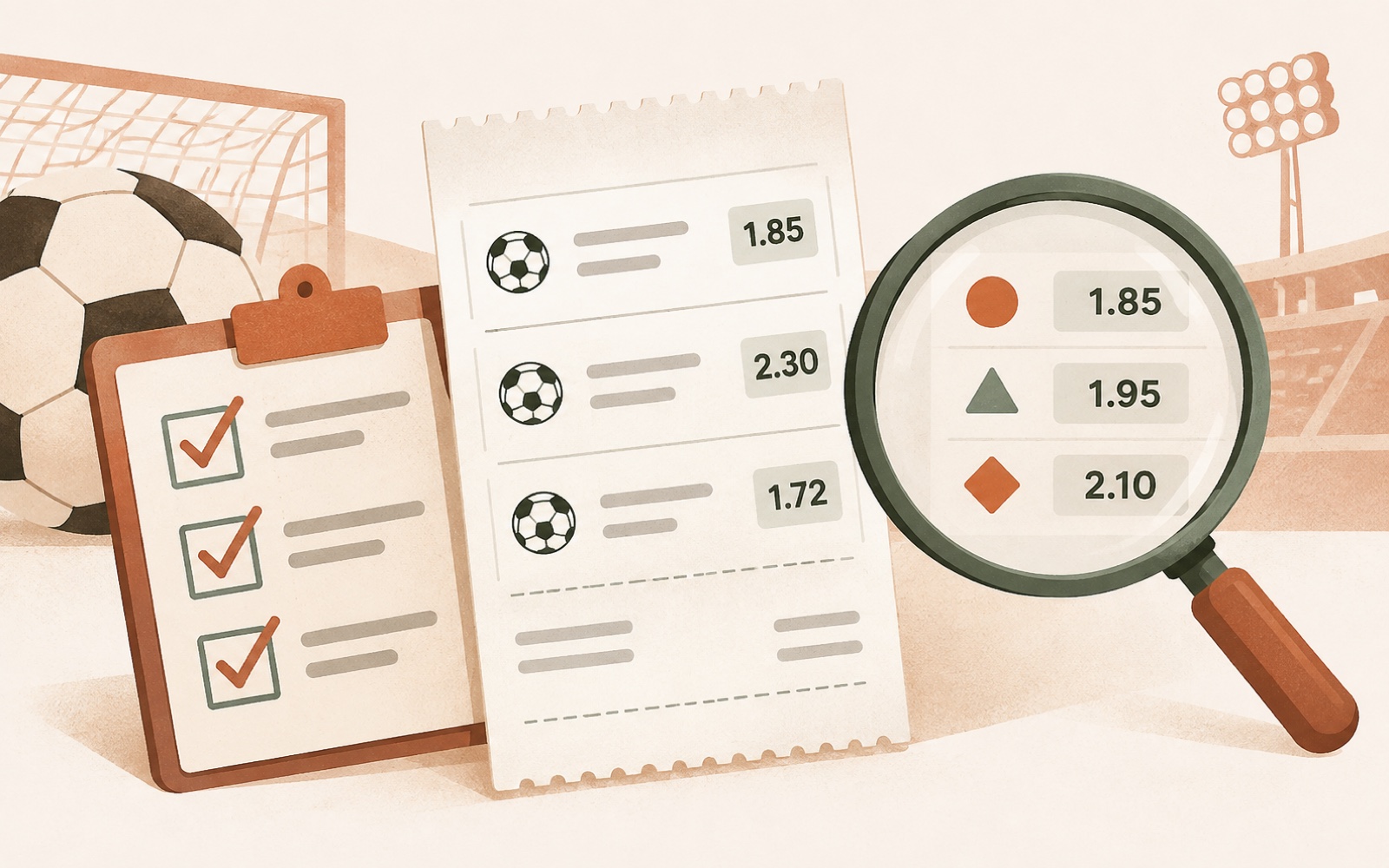
A sensible choice of betting site is made with a spreadsheet head, not a punter's heart. The order you check things in matters as much as the checks themselves, because if you start with the free bet you will talk yourself past the things that actually cost you money. Start with whether the site is legal, move to whether its prices are fair, and only then consider the wrapping.
This page walks through that order. None of it requires opening an account, and most of it can be done in a quiet ten minutes with two or three sites open side by side. By the end you will have compared the numbers that decide long-run value rather than the numbers on the banners.
01
Start with the markets you actually bet
Value is specific to the markets you use, so define them first. A punter who backs Premier League match results wants tight two-way and three-way books; someone who bets each-way on 20-runner handicaps cares about place terms and the margin on a long outright. A site can be excellent on football and mediocre on racing, so a blanket best is meaningless. List your three or four regular market types and judge every site against those.
Doing this first also stops the marketing from setting the agenda. Once you know you want, say, a fair price on cricket and a reliable cash-out, you can ignore the poker room and the casino splash that have nothing to do with your betting.
02
Check the licence before you weigh a single price
No price is worth chasing on a site that cannot legally take your bet. Before anything else, confirm the operator holds a UK Gambling Commission licence by searching the public register, which is updated daily and searchable by business name, trading name, domain or account number. A licensed site must ring-fence customer funds and give you access to alternative dispute resolution; an unlicensed one offers neither.
When writing down a site to compare, note its licensed trading name and account number at this stage. It takes a minute and saves confusion later, especially where one company runs several brands under different domains.
A worked example
Say you find a site advertising heavily on social media with prices that look a shade generous. You search the register by its domain and find no entry, or an entry that lapsed. That single check ends the matter: without a current licence there is no lawful route to recover a disputed stake, so the attractive price is irrelevant.
03
Compare the controls that cap your spend
Every licensed site must offer deposit limits, time-outs and self-exclusion, but the ease of setting them varies, and that ease is worth points. Look for a deposit limit you can set in a couple of taps at sign-up, a clear time-out option, and a visible link to GAMSTOP. A site that buries these tools is telling you where its priorities lie.
For a value-minded punter these controls are budgeting, not just protection. A monthly deposit cap converts an open-ended risk into a fixed cost you can plan around, which is exactly the discipline that separates a hobby from a problem.
| What to check | Why it matters | Where |
|---|---|---|
| UKGC licence | Legal to serve UK, dispute route | Public register |
| Safer-gambling tools | Limits, time-outs, self-exclusion | Account settings |
| Payment terms | Debit only, clear withdrawal times | Banking page |
04
Weigh the odds, the margin and the markets
Now to the number that matters most. Take a selection you would genuinely bet and read the decimal price on each site. Then measure the margin by adding the implied probabilities across the whole market: 1 divided by each decimal price, summed. A total of 1.04 means a 4 per cent overround; 1.09 means 9 per cent. Lower is better, and the gap is money.
Repeat across your regular markets rather than a single headline. A site can be tight on football and wide on racing, so match the comparison to how you actually bet. Our guide to odds and value works through the arithmetic in detail if the conversion is unfamiliar.
Key points
- Check the licence on the UKGC public register before you compare a single price.
- Measure margin by summing 1 divided by each decimal price; under 1.05 is keen, over 1.08 is wide.
- Set a deposit limit at sign-up, and read the withdrawal terms before you fund the account.
05
Test how the money moves in and out
Since April 2020 you cannot deposit with a credit card, so expect debit cards, e-wallets or open banking. That is a feature, not a limit, because it keeps you betting with money you already hold. The real test is the exit: read the stated withdrawal time, note any minimum, and check that winnings return by the same method you deposited.
Verification, or know-your-customer, checks are normal and required, but a well-run site completes them early rather than at cash-out. If the terms hint that documents will be demanded only when you try to withdraw, treat that as a mark against.
A worked example
Two sites both accept a £20 debit deposit instantly. Site A states e-wallet withdrawals within 24 hours and no minimum; Site B states three to five working days and a £10 minimum with weekend processing paused. Same deposit, very different experience when your bet lands, and the banking page told you before you staked a penny.
06
Read the bonus terms as a cost, not a gift
A bonus is money you must turn over on the operator's terms, so price it accordingly. Since 19 January 2026 wagering requirements are capped at 10 times the bonus and mixed sportsbook-and-casino promotions are banned, which removes the worst traps, but a 10x requirement on a £20 bonus still means £200 of turnover before you see a withdrawable penny. Read the minimum odds, the expiry and the game weighting.
Set against a genuinely sharper everyday price, most welcome offers come off worse. Use the bonus as a tie-breaker between two otherwise equal sites, never as the reason to accept wider margins on every future bet.
07
A short checklist before you fund any account
Pull it together into a quick run-through. One, the site appears on the UKGC public register under a current licence. Two, the margin on your regular markets is competitive against at least two rivals. Three, deposit limits and self-exclusion are easy to set. Four, the banking page gives clear, reasonable withdrawal times by your chosen method. Five, any bonus is understood as a cost, with its wagering terms read in full.
If a site fails the first point, stop. If it passes the first but stumbles on price or payments, there is almost always a better option a click away. Choosing well is mostly a matter of refusing to be rushed.
Related reading on this site
- Verifying a licence on the UKGC register
- The maths of odds, margins and value
- Paying in, cashing out and the card ban
- Deposit limits, time-outs and GAMSTOP
- Red flags on an unsafe betting site
How we check our facts
Licensing rules and the public register are published by the UK Gambling Commission; the credit-card ban, slot stake limits and financial risk-check thresholds come from the Commission and GOV.UK; support information is from GamCare and BeGambleAware. Figures and dates last checked 25 September 2026.

Frequently asked questions
What is the first thing to check before opening a betting account?
The UK Gambling Commission licence, every time. Search the site on the Commission's public register by business name, trading name, domain or account number. If it does not appear, no price or bonus is worth the risk, because you would have no legal protection and no dispute route if a payout were refused.
How can I compare betting sites without opening several accounts?
You can see most of what matters while logged out. Prices, market lists and terms and conditions are public, so pick two or three selections you would actually bet, note the decimal odds on each site, and total the implied probabilities to compare margins. Withdrawal times and limits are set out on each banking page. Only open an account once a site clears the licence and price checks.
Should I choose the site with the biggest welcome offer?
No. A welcome offer is a one-off, usually tied to wagering conditions, whereas the margin on the odds costs you on every bet you ever place there. A site with consistently sharper prices will return more over a season than one that leads with a large bonus and takes it back through wider books. Treat the offer as a tie-breaker, not the deciding factor.
How do I test whether a site pays out quickly?
Read the banking page before you deposit and note the stated withdrawal time and any minimums. Complete identity verification early rather than at cash-out, deposit only what you plan to stake, and make a small withdrawal soon after to see how the process behaves. A site that pays a modest sum back promptly and by your original method is showing you the behaviour that matters.